Women knew what to do. A voice AI coach helped them do it.
GAIL tested whether an AI business coach, reached on any basic phone, could help women microentrepreneurs act on what they already know. This is the story from the first survey to the last coaching call.
Phase 1 asked whether phone-based AI coaching could change how women run their businesses. It can.
A business coach in every pocket, even where there's no internet.
The Gender & AI Livelihoods programme, GAIL, is funded by the Gates Foundation and led by Shortlist Futures. It backs organisations using AI to help low-income women across Africa earn more and create jobs. Fortell was selected to build a voice AI coach for women microentrepreneurs in Kenya, delivered on the ground with Inkomoko.
The problem
Training rarely turns into lasting change without someone following up: the knowing–doing gap. And most digital tools assume a smartphone, data and digital skills that many women don't have.
What we built
Two voice agents that work on any handset that can make a call: one that ran the baseline survey in women's own words, and Maryanne, a coach who calls each woman every week, remembers her business and helps her commit to one small action at a time.
Why it matters
Women running small businesses rarely have anyone in their corner week after week. If coaching works over an ordinary phone call, it can reach the women that workshops and apps miss, week after week, in their own language.
Save 100 shillings a day, or 50 on a bad day.
The next call opens by asking how it went.
Almost every woman already knew her next step.
Before coaching began, 118 women completed a voice survey with our AI agent over a standard call. They were experienced traders, many far from any business support, and half named capital as the main thing holding them back.
Nearly all of them described something they meant to do for their business but hadn't yet done. That gap between knowing and doing is what the coaching set out to close.
Read the full baseline →“I need more money to earn more money.”A participant at baseline
Commitments kept more than doubled, and women took the lead.
Share of coaching sessions each month. Kept = the previous commitment was reported as fully done when revisited.
Every call ends with one concrete action, and the next call opens by asking how it went. In June about one in four commitments was fully kept. By September it was more than half.
Over the same months women stopped waiting to be told what to discuss, and by September chose the topic in nearly four sessions in ten.
- Write down one day's sales and spending
- Save 100 shillings a day
- Rearrange the stock display
- Post a few pairs of shoes on social media
How a coaching call works About six minutes, usually in the evening after trading
- 1It remembers herOpens with her last commitment and asks how it went.
- 2She picks the topicA short menu, or "something else on your mind?"
- 3They work it throughRecords, pricing, customers, stock, savings, in English or Kiswahili.
- 4One small commitmentAgreed on the call, then confirmed by SMS.
What changed From the endline survey, September 2026
- Keeping business records, often for the first time
- Saving, and separating business from household money
- Adding new products and clearing dead stock
- Selling through WhatsApp status and social media
- Listening to customers and improving service
Who uses it most The women with the thinnest margins
The women behind the numbers Filmed at their businesses in Kenya
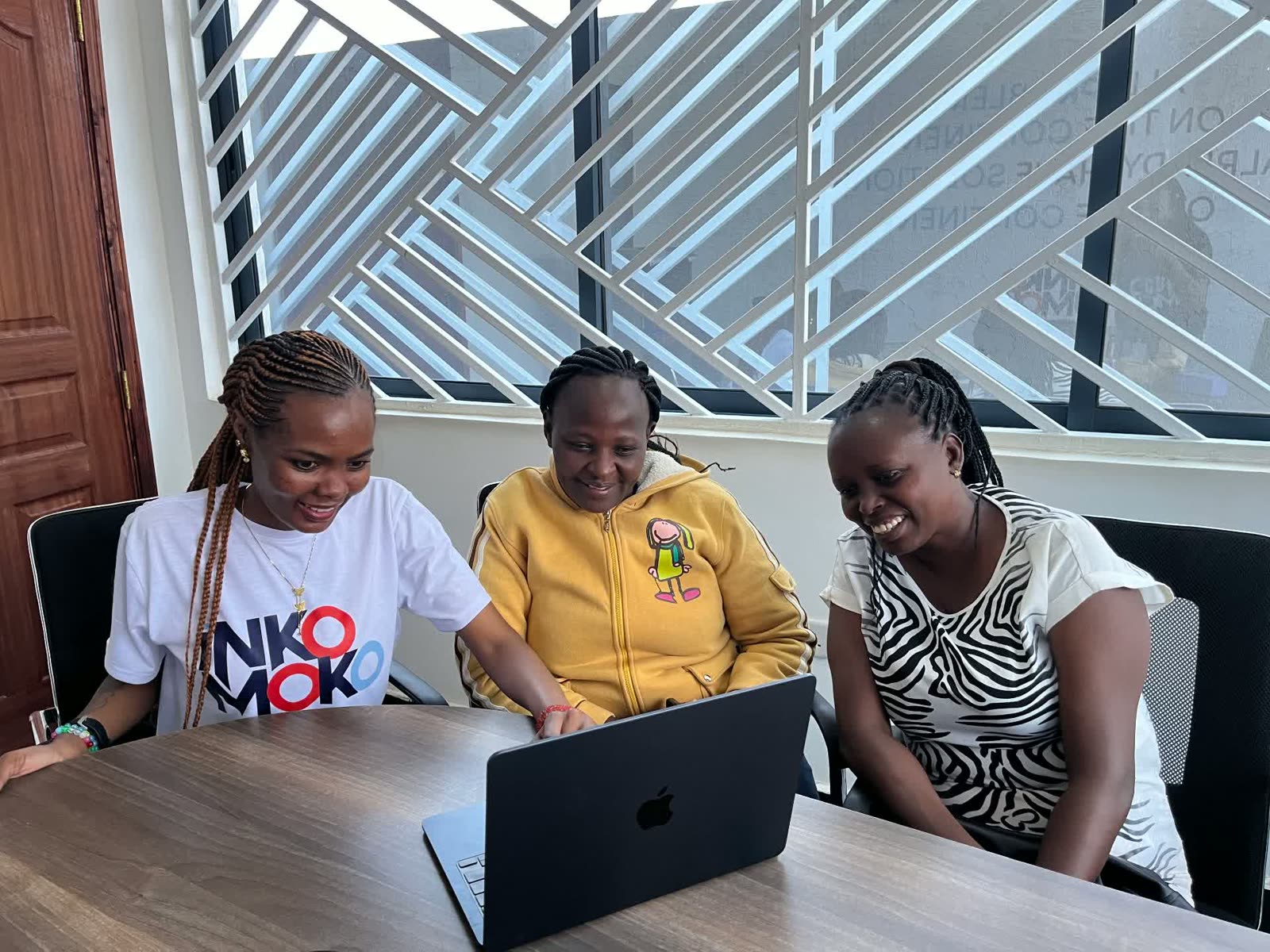
“It has helped me know whether my business is making a profit or a loss.”On keeping records for the first time
“When you put something on your phone, you get a new customer.”On selling online
“Listen to the customer first. Even if I want to answer in anger, I keep quiet.”On customer service
“It helped me see I had dead stock, so I brought new stock to get customers.”On stock · translated from Kiswahili
“The conversations we had, and I took them seriously. Just following up.”On what helped her keep her commitment
From coaching calls and endline interviews. Anonymised, translated from Kiswahili where needed and lightly edited for clarity.
More than twenty improvements in four months.
Field teams tested the coach, listened to calls and visited women in their businesses every week. Each change came from that loop or from patterns in the call data.
- MayBaseline by voice120 surveys in 15 days, over a toll-free line.
- JuneCoaching goes liveEach call shaped by her profile and her last commitment.
- JulyFitted to her dayEvening calls, a warmer introduction, a topic menu.
- AugKiswahili and SMSEveryday Kenyan Kiswahili, post-call summaries, weekly tips.
- SepEndlineBaseline questions repeated, matched woman by woman.
Four lessons we're taking into scale
- The first 30 seconds decide the call.A clear opening with a short topic menu let women lead.
- Language is access, and so is register.Women mix Kiswahili and English; the coach now does too.
- A human moment starts the habit.Women who made their first call at an in-person session engaged far more readily. AI scales the coaching; people start it.
- Advice needs a route to capital.Capital came up in 38% of sessions, so the next version links women to savings groups and finance.
Phase 1 proved the mechanism. Phase 2 scales it.
Phase 2 takes the coach to 600 women. Phase 3 then scales to 1,000, adding a comparison group to measure income effects, letting women choose when they are called, and linking the coach to savings groups and finance.
The VoicePrint framework
One voice instrument, three layers of evidence.
About these figures
Coaching figures cover every call between 10 June and 25 September 2026; a session is a connected call of two minutes or more. Commitment follow-through is the woman's own account, recorded at the start of her next session. Endline figures come from a follow-up survey of participants matched to their own baseline answers; respondents were among the most engaged users, so these results describe engaged users and are descriptive rather than causal. Phase 1 was designed to test the coaching mechanism, not income impact, which Phase 2 will measure with a larger sample and a comparison group. Quotes are anonymised, translated from Kiswahili where needed and lightly edited for clarity.