AI-Enabled Evaluation of the Empowered Worldview Programme
World Vision Burundi partnered with Fortell Impact to pilot an AI avatar-assisted approach to survey implementation for the Empowered Worldview programme. The pilot reached 385 respondents—292 adults and 50 children—alongside 43 qualitative interviews. Conducted in Kirundi, the pilot explored whether digital avatars could improve data quality, reduce social desirability bias, and streamline field operations in a rural, low-connectivity environment.
Background
World Vision sought innovations aligned with organisational priorities, particularly those that could strengthen efficiency in data collection while maintaining—or improving—participant experience. As part of the Empowered Worldview programme, evaluation data is collected from both adults and children, using separate instruments tailored to each group. Both surveys include quantitative indicators and qualitative open-ended questions to capture participants' perspectives in depth.
Exploring AI for rural data collection
Rural humanitarian settings present unique obstacles for monitoring and evaluation: limited connectivity, sparse infrastructure, and the logistical complexity of reaching dispersed populations one-on-one.
Data was collected using Fortell Impact's AI avatars, administered in Kirundi. Participants accessed the survey via smartphone links, interacting with a digital avatar that guided them through structured quantitative items and open-ended prompts. Surveys were deployed independently by participants, with field staff available nearby to provide assistance if needed.
AI avatars for privacy and efficiency
AI avatars improved access and workflow speed. Participants completed interviews privately and at their own pace, reducing reliance on enumerator availability. Field staff noted that data collection could proceed faster without requiring one-on-one facilitation for every respondent. The approach also supported more candid responses on sensitive topics, as participants were not speaking directly to a human interviewer.
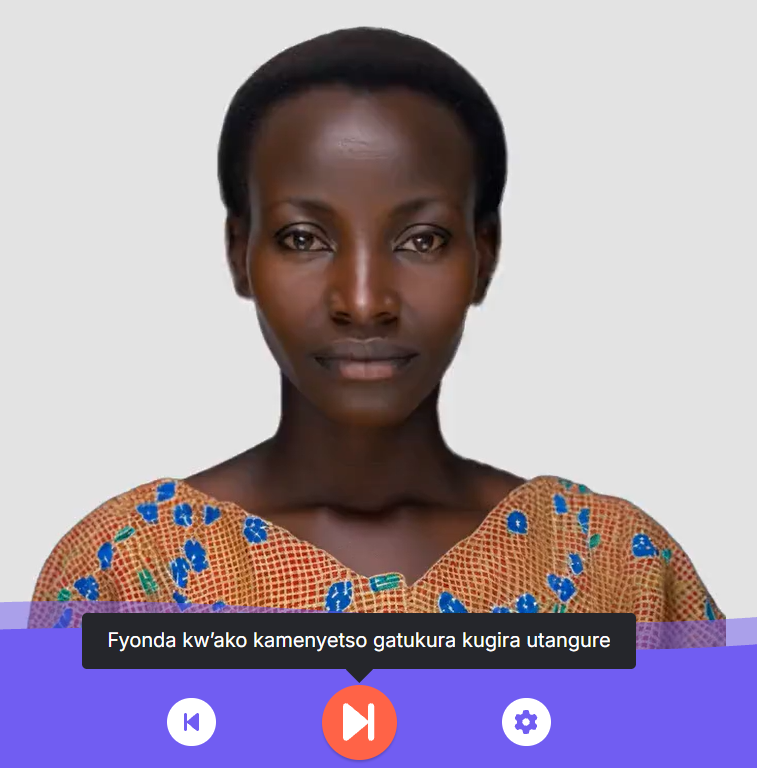
The Kirundi-speaking female avatar used in the World Vision Burundi evaluation
"As an organisation, one of our areas is innovation. How can we leverage technologies to make our work more efficient?"
Diversity of voices captured
By Participant Type
By Gender
"We were able to speed up the data collection process because staff didn't really need to visit each and every person/respondent."
"They had all the privacy and confidentiality... maybe in their houses, at their place of work... at their pace."
"The feedback that we're getting from them, I believe, was very, very accurate because they didn't provide them under any external influence."
Key programme outcomes
Children's Self-Efficacy: 100% of children reached high self-efficacy levels at midline, up from 97% at baseline. The programme empowered children with stronger confidence and belief in their ability to overcome challenges.
Hope for the Future: Children's hope increased dramatically from 43% to 77%. Adults saw even more dramatic improvement—from 28% to 89% feeling hopeful about their future.
Spiritual & Personal Transformation: Adults reported profound shifts in mindset, values, and behaviour—learning to plan ahead, work more diligently, and save money. Faith became a central pillar offering resilience and guidance.
Improved Livelihoods: Participants reported better housing, increased agricultural yields, improved nutrition, and more consistent school attendance. Many families now maintain kitchen gardens and participate in savings groups.
Gender Dynamics: EWV catalysed meaningful shifts in gender relations—greater partnership, shared responsibility, and collaborative decision-making between spouses. Women's groups gained visibility and influence.
Community Solidarity: Striking growth in community cohesion and civic engagement. Stronger relationships, increased mutual aid, and renewed commitment to collective wellbeing through cooperatives and development committees.
Outcome
The experience in Burundi illustrates the feasibility of AI avatar-assisted evaluation in rural humanitarian development settings. While connectivity posed some constraints, the pilot demonstrated that participants—including children—could engage meaningfully with AI avatars. Staff feedback confirmed the potential for efficiency gains and improved data quality, particularly where privacy and neutrality support more honest self-reporting.
Decision Impact
Findings are informing future programme design and monitoring approaches within World Vision.
Have a similar challenge?
We'd be happy to discuss how we might approach your specific context and requirements.